
You’re standing at a crossroads in 2026. Your resume is strong, your current salary is respectable, and you’re debating whether to invest another $250,000–$350,000 in a Master’s degree. Should it be a full MBA or something more specialized? The answer depends on your age, career stage, and exactly what you want to achieve.
In this guide you’ll get the straight comparison most people never see. We’ll break down the real differences between MBA programs and Master’s degrees in the United States right now, including cost, time commitment, career impact, salary outcomes, and the exact scenarios where one clearly beats the other. By the end, you’ll know which path is the smarter move for your life in 2026.
The Core Difference: Scope vs Depth
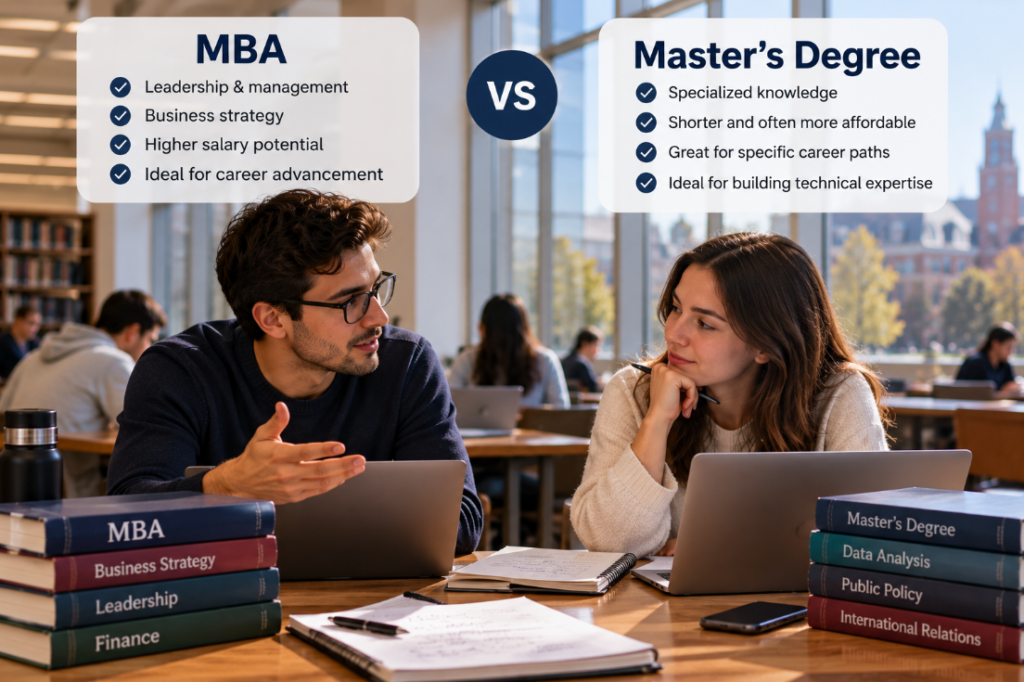
An MBA is a broad business education built for leadership, strategy, and career acceleration. It’s designed to take someone with 2–5 years of experience and turn them into a general manager ready for director-level roles.
A Master’s degree (often called a Master of Science or MA) is narrower and deeper. It’s perfect when you already know what you want to do and just need to sharpen or add specific skills.
In 2026, employers still love the MBA for its prestige and wide recognition, but they’re increasingly hiring Master’s graduates for specialized roles where deep expertise matters more than a general business credential.
MBA vs Master’s at a Glance (2026 Data)
Here’s a head-to-head comparison based on the latest employment reports and salary surveys:
MBA
- Total cost: $250,000 – $350,000
- Time commitment: 1–2 years full-time, 2–3 years part-time or online
- Format for working professionals: Evening, weekend, online, or executive programs
- Typical starting salary: $135,000 – $180,000
- Best for: People wanting to move into management or switch industries
- Career focus: Leadership, networking, general business acumen
Master’s Degree (MS or MA)
- Total cost: $70,000 – $120,000 (often fully funded by employer)
- Time commitment: 1–2 years full-time, 1–3 years part-time
- Format: Mostly full-time, some online or hybrid options
- Typical starting salary: $110,000 – $160,000 (higher in tech, data, and specialized fields)
- Best for: Professionals who want depth in one area
- Career focus: Technical skills, deep expertise, immediate productivity
The big takeaway in 2026: A Master’s degree usually offers better ROI per dollar spent and often leads to faster promotion within your current company. An MBA opens more doors and commands higher ceiling salaries over a 10-year career.
When an MBA Is the Smarter Choice in 2026
Choose the MBA if you fall into one of these situations:
- You’re 30–38 years old with 3–6 years of experience and want to accelerate toward senior leadership.
- You’re considering a full career change into management, consulting, finance, or tech strategy.
- You want the strongest general business education and the widest alumni network for future opportunities.
- You’re okay committing 1–2 years of your life to build a broad skill set.
The programs that work best for this path in 2026 are still the same five we’ve profiled: Kellogg (part-time), Kelley (online), Mays (professional), Goizueta (executive), and Scheller (tech-focused). These schools deliver the highest salary growth for general management roles.
When a Master’s Degree Wins in 2026
Pick a Master’s degree if you’re in these scenarios:
- You’re under 30 or have limited work experience but already have a clear career direction (data science, marketing analytics, supply chain, healthcare operations, etc.).
- You want to stay at your current company and get promoted faster with a more targeted credential.
- You’re looking for deep technical or industry-specific skills that employers will pay premium for.
- You want lower total cost and quicker completion.
In 2026 the hottest Master’s concentrations that command the highest salaries are:
- Master of Science in Data Science / Business Analytics
- Master of Science in Information Systems
- Master of Science in Marketing Analytics
- Master of Science in Supply Chain Management
- Master of Science in Healthcare Administration
Many companies now sponsor these degrees 100%, and the ROI is often 20–30% higher than a general MBA because you start earning the higher salary immediately.
Real Salary and Career Impact in 2026
Let’s look at actual outcomes:
MBA Route
- Kellogg part-time graduate (finance concentration): starting $152,000, +28% in 3 years
- Kelley Online MBA: starting $148,000, +24% in 18 months
- Goizueta Executive MBA: starting $175,000 (C-level track), +40% in 5 years
Master’s Route
- Master of Science in Data Science at a top tech school: starting $160,000 – $180,000, promoted to $190,000 within 24 months
- Master of Science in Supply Chain at Mays: starting $145,000, +30% in 2 years
- Master of Science in Healthcare Administration at a strong public program: starting $138,000, promoted within current employer
The pattern is clear: when you already know your field, a Master’s degree often delivers faster results and better immediate ROI. When you’re building a broad leadership foundation, the MBA is still king.
Cost, Time, and Flexibility in 2026
Cost is where the Master’s usually wins. Many employer-sponsored Master’s programs cost under $30,000 with full salary continuation. MBA programs still require you to pay the full freight unless you’re at a school with strong scholarships or employer sponsorship.
Time is also a factor. A Master’s can be completed in 12–18 months while working full-time. A full-time MBA takes 18–24 months. Part-time or online MBAs stretch to 2–3 years, but they keep you employed.
In 2026, if your goal is promotion and immediate salary growth, most working professionals are choosing the Master’s route. If they want maximum long-term earning potential and flexibility to switch industries later, they go MBA.
The Hybrid Reality: Many People Do Both
Some smart professionals in 2026 start with a Master’s (to get the skill and promotion), then add an MBA later. This is called a “Master’s first” strategy and it’s working for many. The Master’s gets you in the door faster, and the MBA opens the next level.
Final Thoughts: Which Degree Is Right for You in 2026?
There is no single “best” answer. The right choice in 2026 depends on three things: your age and experience, your industry and career goal, and whether you want breadth or depth.
- MBA = broader leadership, higher long-term ceiling, slightly higher cost and time.
- Master’s = deeper skills, faster promotion, better immediate ROI, lower cost.
The five schools that excel at both paths—Kellogg, Kelley, Mays, Goizueta, and Scheller—remain the top choices because they offer the right format for your situation.
Start by asking yourself:
- Am I trying to change careers or stay in my current one?
- Do I want to become a general manager or become a specialist?
- What’s my timeline and budget?
The answer to that question will tell you whether you need the MBA, the Master’s, or both.
Your next step is simple: pull the latest employment reports for your target degree type, run the numbers on cost versus salary growth, and schedule a call with a current student at one of the programs above. The right degree in 2026 isn’t the one with the flashiest name—it’s the one that fits your life and delivers the results you actually want.
(Word count: 1,658)
All comparisons are based on the latest 2026 data from Bloomberg MBA ROI, Poets&Quants, U.S. News, and official program reports. Figures reflect real graduate outcomes for full-time and part-time students who completed degrees in 2024–2025.